
Human-IT: Why I.T. Problems Never Feel Like “Just IT”
Most business owners don’t wake up excited to talk to their IT provider.
They wake up thinking about customers, patients, deadlines, payroll, hiring, schedules, and whether everything will run smoothly today. Technology is supposed to support all of that quietly in the background.
And for a long time, it mostly did.
Lately, though, technology hasn’t been quiet at all.
It’s louder, more complicated, and more fragile than it used to be. Security threats are more aggressive. Software updates feel constant. Compliance expectations keep rising. And when something breaks, it doesn’t just affect one person. It disrupts an entire team.
That’s where most businesses start to feel the strain.
When Technology Breaks, People Feel It First
Here’s the thing most IT conversations miss. IT doesn’t fail on a screen. It fails in the business.
When email goes down, it’s not really an “email issue.” It’s an invoice that doesn’t get sent. A patient message that doesn’t get answered. A sales conversation that stalls.
When a computer runs slowly, it’s not a “device problem.” It’s a frustrated employee. A longer wait time for customers. Someone creating workarounds that quietly introduce risk.
And when security is weak, it’s never just an IT concern. It’s your reputation. Your compliance exposure. And that low-level anxiety that something important could go wrong at any moment.
Technology problems show up as human problems. Stress. Lost time. Broken trust. Constant interruption.
Why Traditional IT Support Often Falls Short
A lot of managed IT providers still work the same way they did years ago.
They set up monitoring.
They wait for alerts.
They respond when something breaks.
They close the ticket.
On paper, that sounds fine. In reality, it’s reactive by design.
And reactive IT is expensive. Not just financially, but emotionally. It keeps teams stuck in interruption mode. It keeps leaders guessing. And it never quite delivers the sense of stability businesses are actually paying for.
The environment has changed. Faster updates. More tools. More threats. More complexity.
But the support model hasn’t kept up
Where the Idea of Human-IT Comes From
Human-IT starts with a simple shift in perspective.
The problem isn’t that people don’t understand technology.
The problem is that technology keeps changing faster than businesses can reasonably absorb.
So instead of treating IT like a series of tickets, Human-IT treats it like an ongoing relationship with the business and the people inside it.
It assumes that support should feel calm, proactive, and human. Not rushed. Not transactional. Not judgmental.
It also assumes that preventing disruption is far more valuable than reacting to it.
What Human-IT Looks Like Day to Day
Human-IT isn’t a buzzword. It shows up in very practical ways.
When someone reaches out for help, they’re already behind. Human-IT means meeting that moment with patience and clarity, not jargon or blame.
It means actively managing systems instead of just watching them. Patching, updating, tuning performance, and reducing risk before issues turn into emergencies.
It means building security around how your business actually operates, not forcing you into a generic checklist that creates friction without reducing risk.
And it means helping leaders make better decisions. What should be replaced. What can wait. What needs to be budgeted for next. No surprises. No guessing.
Over time, that kind of support builds confidence. Teams trust their systems. Leaders stop worrying about the next failure. Growth feels possible again.
Why This Matters Right Now
If you’re a CEO or business owner, some of this probably sounds familiar.
You keep investing in IT, but don’t feel more secure.
Your team is frustrated, but you can’t always see where the cracks are.
Your business is growing, yet your systems feel stitched together.
You don’t want to be the IT decision-maker, but someone has to be.
Human-IT exists because more businesses are hitting this exact point.
The companies that will thrive over the next decade won’t just be the most innovative. They’ll be the ones that protect trust through security, protect time through reliability, and protect their people with support that actually supports.
The Human-IT Promise at Tech Squared
At Tech Squared, we believe technology is only half the story. People are the other half.
Our role is to take IT seriously so your team doesn’t have to think about it constantly. To stay proactive so you’re not stuck reacting to problems. And to show up like humans, because your business is built by humans.
If you’re wondering where to start, here’s a simple question worth asking:
Where is technology slowing your people down right now?
That answer is usually where real improvement begins.
Schedule Your IT Strategy Review Today
About the Author
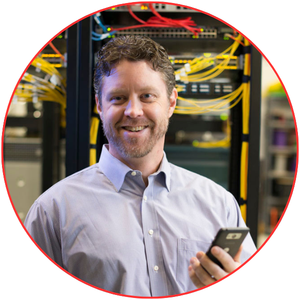 Sean C. Peters is the President and Founder of Tech Squared Inc., an IT services firm he started in 2002 to help businesses solve real technology problems. With over two decades of hands-on experience, Sean and his team specialize in cybersecurity incident response, disaster recovery, and keeping critical systems running when it matters most. He’s led recovery efforts for municipalities, healthcare organizations, and small businesses after major cyber events, often stepping in when previous providers couldn’t get the job done. Sean combines senior-level technical expertise with a straightforward approach that cuts through the noise. When he’s not recovering networks or mentoring his team, he’s focused on protecting the clients who count on him to keep their businesses secure.